
Patient Demand Driven by Side Effects of Existing Therapies Prompts Ab…
페이지 정보

본문
Abovemed’s Wilson’s Disease Drug Candidate ‘ARBM-101’ Receives Positive Signal for Patient Recruitment Ahead of Pivotal Clinical Trial
Abovemed, which is developing ARBM-101, a novel drug candidate for the rare genetic disorder Wilson’s disease, has received an encouraging signal in patient recruitment ahead of its pivotal clinical trial. In rare diseases, patient recruitment is often considered the first major hurdle in clinical development. What makes this case particularly noteworthy is that a patient personally reached out to Abovemed.
The meeting with the patient has also influenced Abovemed’s clinical strategy. The company had originally planned to focus its pivotal trial overseas, but is now internally reviewing the addition of clinical trial sites in Korea.
Abovemed is preparing to enter the first pivotal clinical trial of ARBM-101 in the second half of this year. The candidate, which had previously remained in the preclinical stage with animal studies, is now gaining momentum for clinical development through direct engagement with patients. The Bell visited the scene where the patient personally came to the company to explore the background and the resulting changes in the clinical development plan.
A Patient’s Search for a New Treatment After 40 Years of Limited Options
On the morning of the 10th, when Ms. A, a young college student in her early twenties living with Wilson’s disease, visited Abovemed’s headquarters in Pangyo, Gyeonggi Province, there was a sense of pleasant tension throughout the office. It was the first time since the company’s founding that a patient with Wilson’s disease had visited the headquarters.
With the exception of some researchers, most employees had never had the opportunity to meet a Wilson’s disease patient in person. This was partly because ARBM-101 was still in the preclinical stage, focused mainly on animal studies, but also because Wilson’s disease itself is a rare disorder, making it difficult to encounter patients in everyday life.
The visit came about after Ms. A read a news article reporting that Abovemed had successfully out-licensed ARBM-101. In January, Abovemed signed an agreement with Belgian pharmaceutical company Hyloris for the European rights to ARBM-101. After reading the article, Ms. A directly contacted Abovemed to express her interest in learning more about the drug candidate.
Ms. A said, “I was diagnosed with Wilson’s disease more than 10 years ago and started treatment, but I experienced severe side effects from existing therapies such as trientine. During the dose escalation process, one of the neurological symptoms of Wilson’s disease worsened so severely that I became unable to walk.”
Wilson’s disease is a rare inherited disorder caused by mutations in the ATP7B gene, which encodes a protein involved in copper metabolism. Because copper cannot be properly excreted, it accumulates and causes toxicity in the liver, kidneys, brain, and eyes. The disease occurs in about one in 30,000 people regardless of ethnicity, and more than half of patients progress to chronic liver cirrhosis, often leading to severe disease.
Although treatment was first developed for this rare disease decades ago, the lack of sufficient therapeutic options remains a major limitation. Penicillamine, first developed in 1970, is still used as the first-line treatment. Trientine, approved by the U.S. FDA in 1985, serves as a second-line therapy, but no additional drugs have been approved in the more than 40 years since.
Ms. A said, “I could not tolerate trientine at all, so I have been taking zinc therapy for several years because it is considered safer and has fewer side effects than other copper-chelating agents. Still, the burden of having to take it on an empty stomach and the gastrointestinal discomfort remain. On top of that, my symptoms have not improved at all despite taking the medication, so I became frustrated and began searching for new treatment options myself. That is how I learned about Abovemed and ARBM-101.”
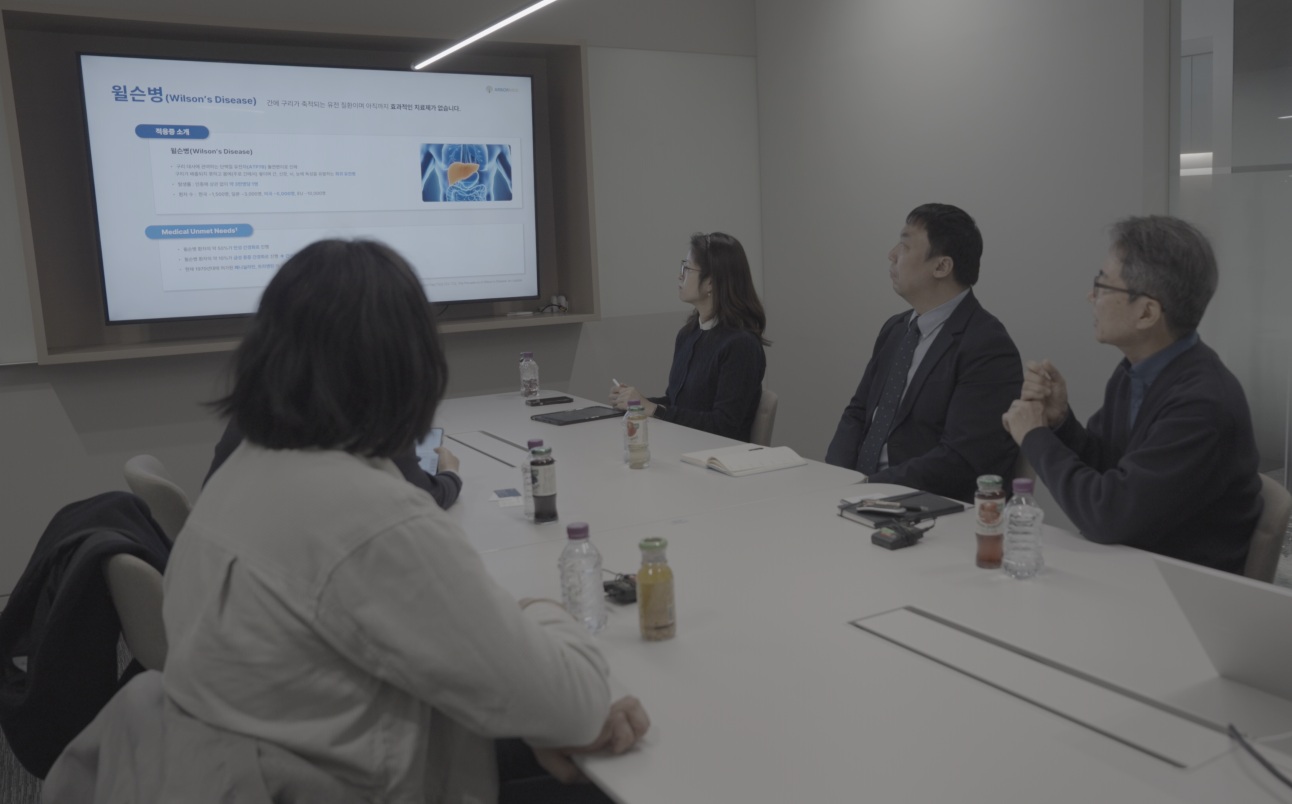
ARBM-101, Initially Planned for Phase 2 in London, Now Considering Korean Clinical Sites
ARBM-101 is a small peptide-based drug candidate designed to selectively bind copper. At the core of its mechanism is a microbial molecule called methanobactin. This molecule selectively binds to copper in the body and facilitates its excretion through feces. Since people without the genetic mutation also naturally excrete copper through feces, the therapy may enable effective copper removal without the risk of additional copper accumulation. The copper-removal effect has already been confirmed in animal models including mice and pigs.
Lim Won-bin, Co-CEO and Chief Technology Officer (CTO) of Abovemed, said, “A key feature of ARBM-101 is that it can induce copper excretion with intravenous (IV) administration once every one to three months. Because it acts directly on the liver, it may also be suitable for treating severe patients. We believe that even patients whose neurological symptoms have already progressed may show improvement if copper is continuously removed.”
Gene therapies are also being developed as competing approaches, but in reality, development has been slow due to limitations such as the risk of immune rejection, the difficulty of repeat dosing, and uncertainty regarding long-term efficacy.
Lim added, “Since Wilson’s disease is a genetic disorder, the ideal solution would of course be a gene therapy. But that is not easy. At present, the best approach is to remove copper safely and conveniently from the body through the mechanism of ARBM-101.”
On that day, the question Ms. A and her mother were most eager to ask was naturally about the timing of the clinical trial and whether she might be able to participate. Abovemed plans to enter the pivotal clinical stage for ARBM-101 in the second half of this year. Phase 1a, which is intended to evaluate safety and tolerability, will be conducted in healthy volunteers in Korea and other locations. Ms. A will not be eligible to participate in that study.
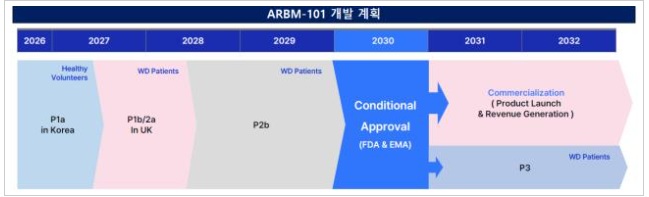
Originally, it would also have been difficult for her to participate in the Phase 2 study involving Wilson’s disease patients. Abovemed had been planning to conduct Phase 1b/2a and Phase 2b primarily in London, where one of the members of Abovemed’s global clinical advisory board serves as the principal investigator (PI). This PI was previously involved as the PI for Alexion’s ALXN1840 trial and has access to a patient cohort of around 300 individuals.
Lim said, “In Korea, there are currently about 1,500 to 1,800 patients with Wilson’s disease. When Alexion conducted the Phase 3 trial of ALXN1840 in Korea in 2019, the target enrollment was 180 patients, but only five were actually recruited, making it impossible to properly conduct the trial. That is why we had not been considering a Korean clinical site.”
However, following the meeting with Ms. A, Abovemed has now decided in principle to conduct the Phase 2b trial in Korea as well. Lim’s strong commitment played a decisive role in this change. The Phase 2b trial is expected to begin as early as the second half of 2028.
Lim said, “Although patient recruitment in Korea may be challenging, the ultimate purpose of drug development is to overcome disease and improve patients’ quality of life. For that reason, we plan to open an additional clinical trial site in Korea. We hope ARBM-101 can become a source of hope for patients with Wilson’s disease.”
관련링크
- 이전글Arbormed Secures USD 1.6 Million Investment from U.S.-Based OIC… Pre-IPO in Full Swing 26.04.21
- 다음글Arbormed and Penmix Apply for U.S. FDA Approval of Complex Generic 'Sugammadex' 26.02.10
댓글목록
등록된 댓글이 없습니다.
